Trauma is not a headline or a single event. It is a change in the way the body and brain track threat. Long after the danger has passed, a noise, a smell, a glance can yank someone into the past. The present becomes blurry, and the body reacts as if it is still there. Mindfulness, done well, helps people find ground again. Not by forcing calm or telling stories about resilience, but by locating actual safety, breath by breath, sensation by sensation, in real time.
I have sat with hundreds of clients at that edge where the present feels paper thin. Some come after recent losses, some after childhood harm that has shadowed every decade since, and some after medical emergencies that rewired their confidence in their own bodies. The common thread is a nervous system that has learned to survive by staying on high alert. Mindfulness in trauma therapy is about giving that system options. Not a slogan, a skill.
What mindfulness means when there is trauma
There are many versions of mindfulness in popular culture. Most miss the point when trauma is involved. The work is not to empty the mind or aim for neutrality. It is to build a reliable way to check what is happening right now, inside and outside, and to choose a response that keeps the person within a workable range. This is not passive. It is pragmatic and often physical.
If someone is used to bracing for harm, eyes scanning exits, shoulders locked, the invitation is small and precise. Feel both feet. Notice the chair. Let the eyes land on one color in the room. Thirty seconds of that kind of orienting does more than a ten minute meditation script read aloud without attunement. It tells the body, this is where we are, and it is different from where we were.
In practice, that looks like titration, the slow dosing of attention. We touch the difficult memory or sensation for a breath or two, then return to a neutral anchor. It might be the pressure of the thighs on the seat or the feeling of air at the nostrils. Over sessions, that seesaw between activation and settling widens the window of tolerance. Clients start to recognize the micro-signs that they are leaving the present and can steer back before they are swept away.
Safety is not a promise, it is a practice
Trauma therapy often begins with relief that someone is finally listening, and fear that it will get worse before it gets better. The fear is reasonable. We do not rush the body. Mindfulness gives us a way to pace the work responsibly. Before we open old doors, we build exits, both literal and internal. We agree on signals for pause. We decide together what settling looks like, not in abstract words, but in observable cues: shoulders down a centimeter, jaw less clenched, eyes blinking more often, voice a half-step slower.
A client once told me she felt childish asking to keep a weighted blanket on her lap during sessions. She believed progress required stoicism. I disagreed. The blanket was not a crutch. It was weight bearing. It allowed her to stay present, feel parts of her body that were otherwise numb, and track the shift from frost to thaw. Over three months, the blanket went from essential to optional. The progress was not bravado. It was nervous system learning.
How the body keeps score, then updates it
The language of trauma is sensation before it is story. Tightness in the chest, shallow breath, cold hands, a surge of heat, a tunnel of vision. These are not overreactions. They are the body trying to protect, often based on old data. Mindfulness helps us gather new data with care. We map how activation rises, plateaus, and falls. For some, the rise is fast and the fall is slow. For others, it is a flat line until a sudden drop into shutdown.
Rather than labeling these patterns as irrational, we treat them as signals to be decoded and updated. We check them against the present. In one session, a father noticed that every time his daughter laughed loudly in the next room, his shoulder muscles seized. He was embarrassed until we traced it back to years of suppressing any sudden noises in a volatile household. The present-moment check was simple: toes on the floor, look at the window, feel the room temperature, name the year. Pairing his daughter’s laughter with these cues of current safety over several weeks loosened a grip that decades of self-blame had not.
The craft of anchoring
Anchors are the tools that pin awareness to the here and now. They must be specific, countable, and personally effective. A generic instruction like “notice your breath” fails for many trauma survivors. Breath can be a trigger if it was disrupted during an assault or a medical emergency. Likewise, closing the eyes can increase vulnerability for someone with a history of night terrors or confinement.
Better anchors might be the weight of shoes, the coolness of a ceramic mug, the outline of a doorframe, or the sound of traffic two blocks away. Some clients prefer proprioceptive anchors like pushing feet into the floor for two seconds, then releasing. Others track the pattern of light and shadow on a wall. I often invite people to find at least two anchors they can access at any time without equipment. One might be bodily, the other environmental. With those in hand, they can ride out spikes of activation without leaving the room or dissociating.
When presence meets memory
Mindfulness does not erase memory. It changes the relationship to it. In trauma therapy, we often meet memories as fragments. A smell without an image, a sudden pain in the stomach with no narrative, a clip of sound. The mind tries to fill in the gaps, sometimes with guesses that fuel shame. Mindfulness slows the rush to interpret. We track exactly what is here: a sour smell like old carpet, a high whine like a fluorescent light, a weight in the chest around the size of a softball. Describing with this level of detail grounds the experience and builds tolerance.
This precise witnessing is helpful during memory processing methods, including EMDR therapy. In EMDR’s early phases, we focus on stabilization and resource building. Mindfulness is the backbone there. Clients learn to notice the first tremor of activation and use pre-chosen anchors. During desensitization, when we invite the memory network to shift through bilateral stimulation, mindful awareness helps titrate exposure. If distress spikes above a set threshold, we pause, orient, and return to present cues. After the sets, we check for residual sensations and thoughts, then close the session with a clear return to the room. Practitioners who treat mindfulness as optional often see clients leave dysregulated. The session is not complete until present-moment safety is restored.
Working with couples when trauma sits between them
Couples therapy gets complicated when one or both partners have trauma histories. Arguments are not just about dishes or schedules. They are about attachment alarms and survival reflexes. Mindfulness helps couples notice the chain reaction in real time. One partner’s flat tone lands as contempt, the other’s raised voice registers as danger, and both bodies move into fight, flight, or freeze. If we can name this as a loop, not a verdict, we can interrupt it.
I teach couples micro-pauses. Ten to twenty seconds, tops. Eyes open, feet down, describe one neutral detail in the room, then name one need using plain language. Not an essay, five words or fewer. For example, “I need a slower voice,” or “I need a two minute break.” The goal is not to sterilize emotion. It is to keep both people within a range where listening is possible. Over time, they build a shared practice of de-escalation. The relationship becomes a place where present-moment safety is co-created, not assumed.
Children find safety through play, not lectures
Child therapy with mindfulness looks different than adult sessions. Kids regulate through movement, rhythm, and relationship. Asking a nine-year-old to sit still and scan their breath for five minutes can backfire. Instead, we use games that naturally anchor attention. Passing a ball back and forth while naming objects in the room by color. Walking the room like detectives, listing three quiet sounds, two steady shapes, one thing that smells safe. Drumming patterns with hands on knees and matching the beat with words, like the child’s name or the name of their pet.
Caregivers carry the practice home. A practical routine might be a two minute grounding ritual before bed or after school. Not dramatic, just consistent. The goal is not to stop big feelings. It is to help the child and the adult track and recover together. Over a span of weeks, teachers and parents often report fewer meltdowns that come out of nowhere and quicker returns to baseline after stress.
Adapting mindfulness for neurodivergent therapy
Many neurodivergent clients value precision, predictability, and sensory honesty. The usual scripts can be grating or confusing. We adapt. Some prefer counting or visual grids to track attention. Others want to stim openly, which can be inherently regulating. Eye contact can be optional or avoided. If interoception is unreliable, we lean on exteroceptive anchors, like textured objects, weighted items, or visual patterns.
Language matters. Phrases like “soften your body” might not land. Better would be “check your jaw muscles and decide if you want less tension,” or “notice your shoulder angle by degrees.” For clients with auditory sensitivity, guided practices might be written or shown as icons. I have worked with autistic adults who excel at mindful systems. They design a personal protocol for spikes, with clear steps and a timing chart. It is not rigid. It is relief through predictability.
Building a plan you can use under stress
Mindfulness only helps if it shows up when you need it. That requires rehearsal. We practice when stakes are low, then gradually add challenge. A client with panic related to driving found that she could not remember any skills once the highway merged. We built a ritual that began before the keys left the hook. Two grounding steps in the kitchen, one in the car, then a check-in at the first red light. She kept a two-line card on the dashboard, not a paragraph. After about six weeks of steady practice, she reported that the first wave of panic was now smaller, and she could stay on the road without white-knuckling for the entire commute.
Here is a compact sequence many clients find useful when symptoms rise quickly:
- Name five facts about the present that were not true in the past event you fear. Keep them concrete, like the color of the walls or the month. Choose one sensory anchor you can feel right now, for ten slow seconds. Rate your current distress on a 0 to 10 scale. If above a pre-set number, switch to movement for sixty seconds, like paced walking or shoulder rolls. End by orienting to the nearest safe person or exit, even if you will not use it. Let your eyes rest on their shape.
Practice this sequence outside of crises, twice a day for a week, and then during mild stress. It becomes easier to find under pressure because you built a groove for it.
Working alongside EMDR therapy, not against it
Clients often ask whether mindfulness will dilute EMDR therapy or make it unnecessary. In my experience, it does neither. It makes EMDR safer and more effective. EMDR’s eight phases already include preparation, assessment, desensitization, installation, body scan, closure, and reevaluation. Mindfulness skills strengthen three of those markedly: preparation, so that clients can self-regulate; body scan, so that residual activation is caught and addressed; and closure, so that the nervous system leaves the session oriented to the present.
There are edge cases. If a client dissociates quickly with bilateral stimulation, we may slow down or switch to a more present-focused approach for several sessions. We might replace eye movements with tactile buzzers at lower intensity and keep the eyes open, scanning the room for orienting. Mindfulness here prevents further splitting off and helps integrate fragments into a more coherent whole. Progress is rarely linear. Expect spurts and plateaus, and track function, not only symptom scores.
What progress looks like in real life
When people imagine healing, they picture serenity. In my office, progress often looks like shorter spirals and better recoveries. A person who used to lose two days to a flashback now loses two hours. Nightmares move from nightly https://martinkues056.timeforchangecounselling.com/trauma-therapy-for-survivors-of-emotional-abuse to twice a month. Crowds move from impossible to manageable for ninety minutes. These are not small wins. They translate into relationships sustained, jobs kept, and children greeted with a steadier voice.
We measure gains both subjectively and behaviorally. Distress ratings can drop from 8 to 5 in-session within five minutes, which is meaningful if the person can also state what helped and repeat it at home. Over eight to twelve weeks, many clients report improved sleep by 30 to 50 percent, fewer startle responses, and more choice under stress. Choice, not constant calm, is the gold standard.
Common mistakes and how to avoid them
Three patterns derail good intentions. The first is overexposure. People try to power through terrifying memories without enough anchoring, which increases symptoms. The second is spiritual bypass, using lofty language to float away from pain rather than meeting it with care. The third is rigid technique. If a practice makes you feel worse every time, it is not your fault and not a moral test. You change the tool.
Therapists stumble too. We can overcue, talking clients out of their bodies. We can undercue, leaving them alone inside a storm. We can fall in love with a protocol and forget the person. The antidote is attunement and collaboration. We ask, what is your body telling you now, and what would make two percent more safety possible in the next minute?
A brief safety checklist for at-home practice
- Choose one physical anchor and one visual anchor you can access anywhere. Set a clear stop rule, like pausing if distress is above 7 out of 10 for more than sixty seconds. Tell one supportive person what you are practicing and how they can help. Keep a two line plan card in your wallet or phone, not a long script. Schedule practice during neutral times, not only when you feel terrible.
These small structures prevent spirals and build trust in your own capacity.
The therapist’s stance matters
Techniques help, but the relationship shapes the nervous system most. A therapist who breathes at a human pace, tracks your cues, and respects your limits gives you a living model of safety. We move at the speed of trust. Sometimes that means we spend a session walking the hallway to practice re-entering a room. Sometimes it means celebrating that a client finally noticed their jaw unclench for five minutes while watching a show. These are not detours. They are the path.
A stance of humility is key. I do not know anyone’s body better than they do. I have a map, but the client sets the pace. For survivors who have had too many experiences of being pushed, coerced, or minimized, this is part of the repair. It also yields better outcomes. Autonomy and choice are not just ethical. They are efficient ways to teach a nervous system that it is safe enough to learn.
When mindfulness is not the first move
There are times when mindfulness practices should be modified or deferred. Active substance withdrawal, uncontrolled psychosis, or acute suicidality may require medical stabilization first. For survivors of chronic torture or captivity, extended body scans can trigger overwhelming responses. In those cases, we work with micro-anchors and external orientation for weeks before any inward focus. Movement-based regulation, like slow paced walking with visual scanning, can be gentler and more effective early on.
Similarly, some people with complex trauma find breath-focused practices aversive. It is not a failure to skip them. There are dozens of other gates to the present. The right one is the one that opens without slamming shut behind you.
Real vignettes, lightly disguised
A nurse in her thirties came to therapy after a code blue on her unit. The sound of the crash cart followed her home. We built a 90 second arrival ritual before each shift, including naming three blue objects in the break room and pressing her palms to the cool metal of the sink. At night, she practiced orienting to the quietest sound in her apartment for thirty seconds before bed. After eight weeks, the cart sound still grabbed her, but it let go faster. She stopped avoiding the hallway where the cart lived.
A retired teacher struggled with touch after recovering from a long ICU stay. EMDR therapy helped reprocess the most frightening moments, but it was mindfulness during daily grooming that rebuilt trust in her body. She brushed her hair with slow attention to the scalp, naming the year and the room each morning. That tiny ritual cut her daily anxiety by a noticeable margin and allowed her to hug her grandchildren without freezing.
A couple in their early forties found that arguments over money turned brutal within minutes. We taught them to pause for fifteen seconds, plant both feet, and say one need in five words. Over three months, fights still happened, but they no longer rewrote their entire bond. They could repair within the hour. Both partners reported feeling safer to bring up hard topics because there was a way back.
Taking the next step
If this approach resonates, you can begin today with modest, repeatable practices. Spend thirty seconds, twice a day, noticing two anchors that are available in your usual spaces. Track which ones bring a measurable shift. Write a two line plan for spikes and rehearse it when you are calm. If you are working with a therapist, ask how mindfulness can support your goals, whether you are doing EMDR therapy, more traditional trauma therapy, couples therapy, or child therapy for your family. If you are neurodivergent, name your sensory needs and preferences bluntly. The tools should adjust to you, not the other way around.
The heart of mindfulness in trauma care is not perfect calm. It is the felt sense that you can locate the present, make choices from there, and return to yourself after you are pulled away. That sense grows with practice, in small, durable increments. Over time, the room gets larger. The exits are clearer. Your body believes you when you say, I am here, and for this moment, I am safe enough.
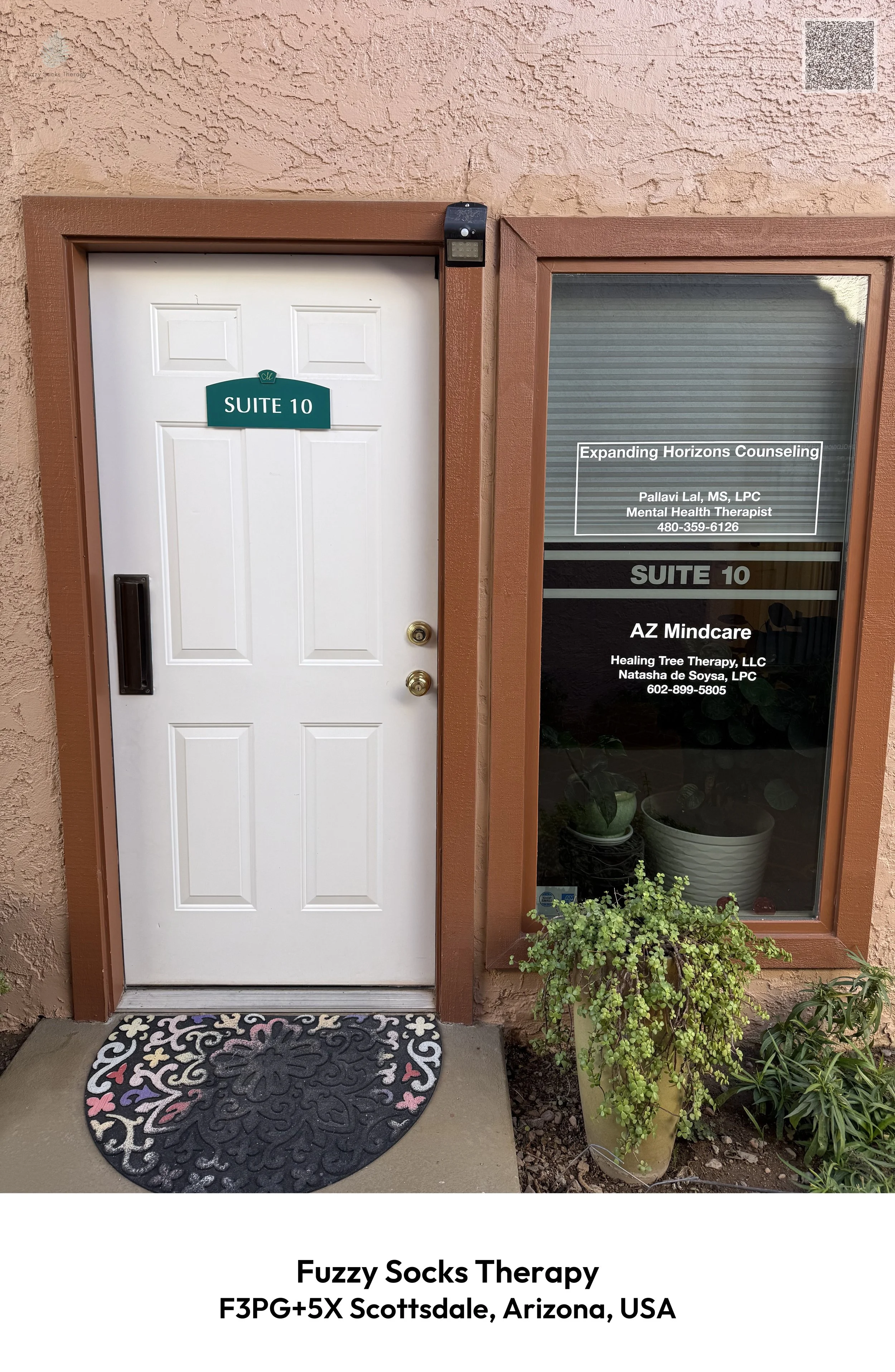

Address: 3295 N. Drinkwater Blvd., Suite 10, Scottsdale, AZ 85251
Phone: (720) 378-8454
Website: https://www.fuzzysockstherapy.com/
Email: [email protected]
Hours:
Monday: 9:00 AM - 5:00 PM
Tuesday: 9:00 AM - 5:00 PM
Wednesday: 9:00 AM - 5:00 PM
Thursday: 9:00 AM - 5:00 PM
Friday: 9:00 AM - 5:00 PM
Saturday: Closed
Sunday: Closed
Open-location code (plus code): F3PG+5X Scottsdale, Arizona, USA
Map/listing URL: https://maps.app.goo.gl/cqhwvXU4UMg6QL1YA
Embed iframe:
The practice offers in-person therapy in Scottsdale along with online sessions for clients in Arizona, Colorado, and Florida.
Clients can explore services such as trauma therapy, EMDR therapy, Deep Brain Reorienting Therapy, neurodivergent therapy, child therapy, couples therapy, discernment counseling, and parenting intensives.
Fuzzy Socks Therapy is especially relevant for people navigating trauma, dysfunctional family dynamics, ADHD, autism, relationship conflict, and emotional overwhelm.
The website presents a direct, practical therapy style focused on real tools and meaningful change rather than vague advice.
Scottsdale clients looking for trauma-informed psychotherapy can find support that combines deeper healing work with concrete skill building.
The practice also offers help for adult children of dysfunctional families, couples on the brink, and neurodivergent kids, teens, and adults.
To get started, call (720) 378-8454 or visit https://www.fuzzysockstherapy.com/ to book a free consultation.
A public Google Maps listing is also available for Scottsdale location reference alongside the official website.
Popular Questions About Fuzzy Socks Therapy
What does Fuzzy Socks Therapy help with?
Fuzzy Socks Therapy helps with trauma, dysfunctional family patterns, neurodivergence, relationship conflict, emotional overwhelm, and related challenges for individuals, couples, and families.
Is Fuzzy Socks Therapy located in Scottsdale, AZ?
Yes. The official website lists the office at 3295 N. Drinkwater Blvd., Suite 10, Scottsdale, AZ 85251.
Does Fuzzy Socks Therapy offer in-person and online sessions?
Yes. The official site says the practice offers in-person therapy in Scottsdale and online therapy in Arizona, Colorado, and Florida.
What therapy approaches are listed on the website?
The website highlights EMDR therapy, Deep Brain Reorienting Therapy, discernment counseling, play therapy, Dialectical Behavior Therapy, Emotionally Focused Therapy, and practical trauma-informed skill building.
Who provides therapy at Fuzzy Socks Therapy?
The official website identifies the therapist as Lianna Purjes.
Does the practice offer couples counseling?
Yes. The website includes couples therapy, couples intensives, and discernment counseling for couples deciding whether to stay together or separate.
Does the practice work with children and adolescents?
Yes. The site says the practice offers child therapy and support for children, adolescents, and their families.
How can I contact Fuzzy Socks Therapy?
Phone: (720) 378-8454
Email: [email protected]
Website: https://www.fuzzysockstherapy.com/
Landmarks Near Scottsdale, AZ
Drinkwater Boulevard is the clearest local reference point for this office and helps nearby clients place the practice in Scottsdale. Visit https://www.fuzzysockstherapy.com/ for service details.
Old Town Scottsdale is a familiar city landmark and a practical reference for people searching for therapy near central Scottsdale. Call (720) 378-8454 to learn more.
Scottsdale Civic Center is another recognizable local landmark that helps define the surrounding area for nearby professional services. The official website has current contact details.
Scottsdale Stadium is a well-known destination in the city and a useful point of reference for local users. Fuzzy Socks Therapy offers both in-person and online sessions.
Indian School Road is a major corridor that helps many residents orient themselves in Scottsdale. More information is available at https://www.fuzzysockstherapy.com/.
Fashion Square and the surrounding central Scottsdale area are widely recognized by local residents and visitors alike. Reach out through the website to book a free consultation.
Downtown Scottsdale is a strong local search reference for people seeking counseling and psychotherapy services in the area. The practice serves Scottsdale in person and multiple states online.
Scottsdale Road is another major route that helps define the broader service area for clients traveling from nearby neighborhoods. The practice supports individuals, couples, and families.
The Scottsdale arts and civic district is a useful area reference for those familiar with the city center. Visit the site to review specialties and next steps.
Central Scottsdale commuter corridors make this practice relevant for nearby residents who want in-person therapy, while online sessions add flexibility for clients in Arizona, Colorado, and Florida.